Five minutes from Gelsomoro, up a narrow road that winds through olive groves, is a medieval village that stops most people in their tracks.
Torre di Palme sits on a rocky spur above the Adriatic, high enough that on clear mornings you can see all the way to Monte Conero. It has the dense, unhurried quality of a place that has been inhabited for roughly three thousand years and has no particular interest in explaining itself to visitors. Since 2017 it's been a member of I Borghi più Belli d'Italia — the association of Italy's most beautiful villages — which is the official confirmation of what anyone who walks its streets already knows.
This is the village we walk to in the evening. This is what's waiting five minutes up the road.
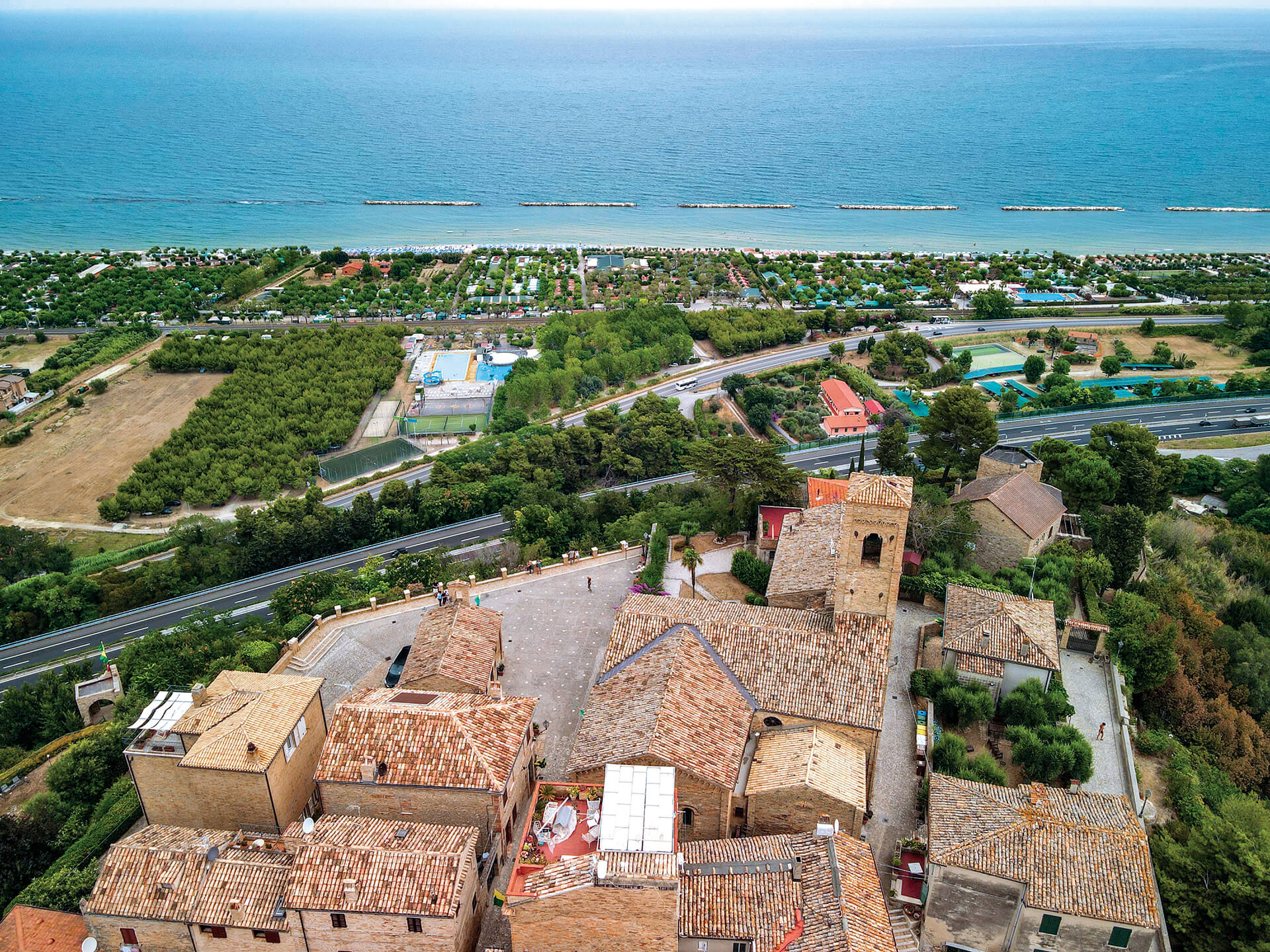
Torre di Palme from above, with the Adriatic beyond. Photo: visitfermo.it
A village that goes back to the Paleolithic
The territory of Torre di Palme was already inhabited in the Paleolithic. Pliny the Elder called it Ager Palmensis. The Picenes — an ancient seafaring people of the early Iron Age — settled the hills behind the coast and left behind a necropolis that has attracted the interest of National Geographic.
The name itself comes from a wine: the Palmense, produced by the Picentes, was appreciated far beyond local borders. The writers Varrone and Columella both mention the Città di Palma. The settlement became Turris Palmæ — Tower of Palme — when it was fortified in the early Middle Ages.
In the ninth century, Hermit monks arrived from the coast and founded the Church of San Giovanni Battista. Around that church and the old fortifications, the village as we know it today began to take shape in the twelfth century. What grew was a fierce medieval castle with a solid defensive system — the kind of place that spent centuries in a tug-of-war between the Papacy, the Empire, and the neighbouring city of Fermo. It was only in 1877 that Torre di Palme voluntarily joined Fermo's municipality, ending seven centuries of proud independence.
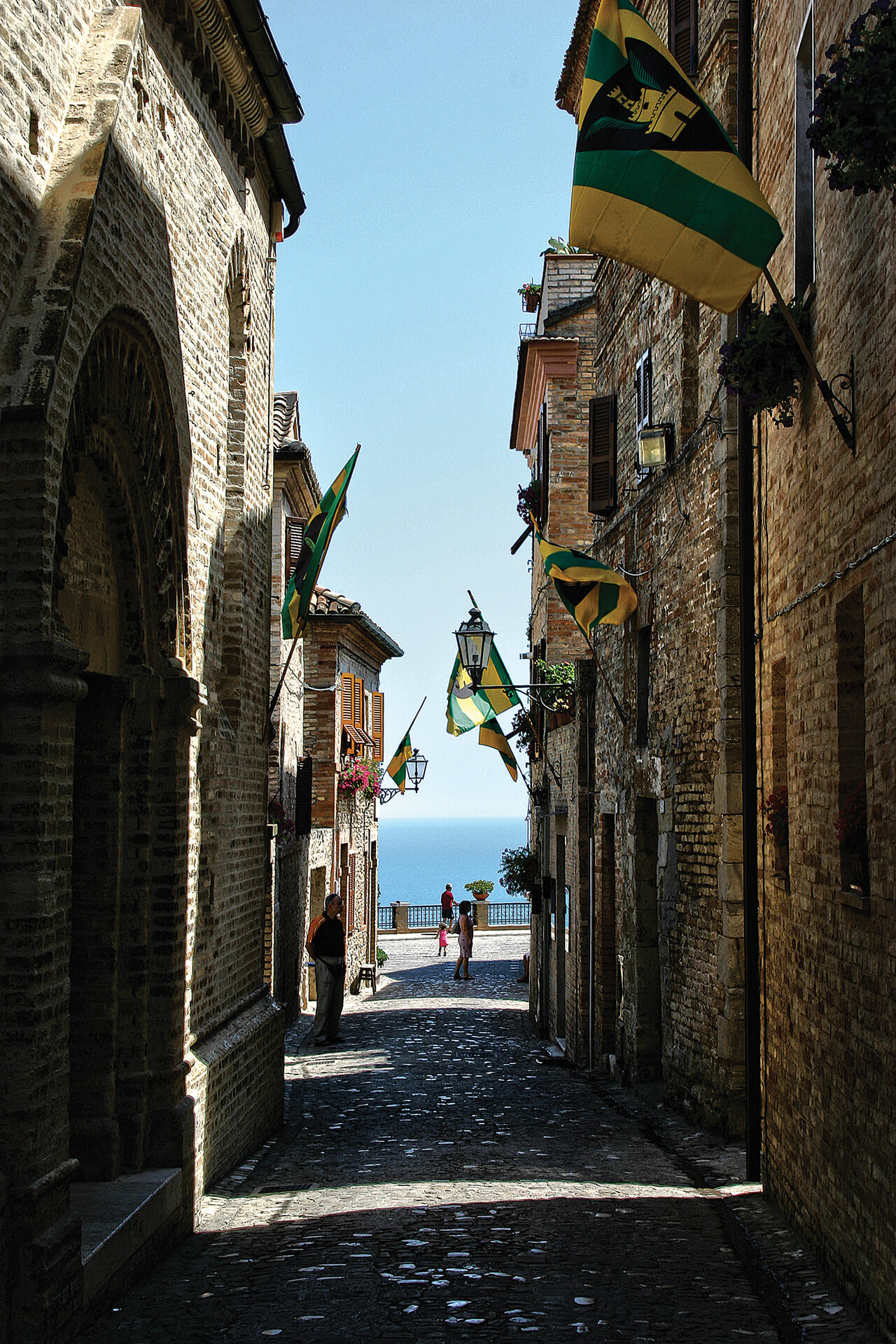
The narrow streets of Torre di Palme. Photo: visitfermo.it
Walking the village
The pleasure of Torre di Palme is mostly a pleasure of walking. The main street runs along the ridge, flanked by terracotta-faced houses with geraniums spilling from the windows — and between the buildings, sudden frames of sea and hillside that stop you mid-stride.
What to look for as you walk:
The St. Augustine Temple, midway along the main street, contains a Polittico by Vittore Crivelli from the end of the fifteenth century — a polyptych of exceptional quality, its glazed colours still luminous against golden backgrounds. The painting has a dramatic history: it was smuggled out of the village in 1972, almost entirely recovered the following month, and then restored. Four tiles of the predella are still missing. The painting that remains is worth standing in front of for longer than you think.
The Church of Santa Maria a Mare dates to the twelfth and thirteenth centuries. Its Romanesque-Gothic structure contains ceramic bacini from the fourteenth century — majolica decorations on the sacristy walls — and a gentle Madonna di Loreto from the fifteenth. At the end of the church's avenue is the panoramic viewpoint that frames Porto San Giorgio, the modern tourist port below, and beyond it the ancient sanctuary that gives the church its name.
The Archaeological Museum is small but worth an hour. The remains of Picene tombs are there, along with the kind of local historical objects that give texture to everything else you're looking at outside.
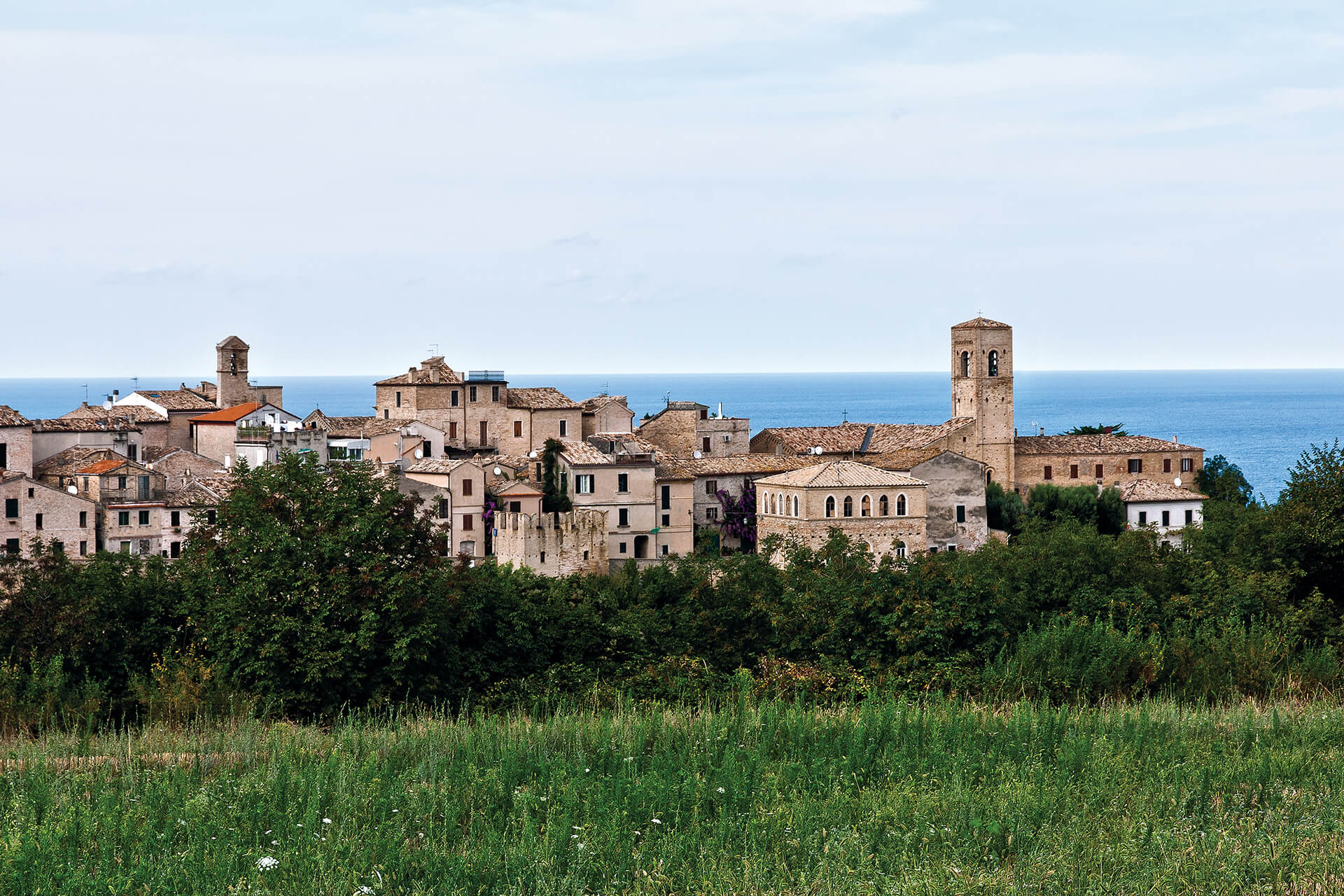
The view from the panoramic terrace. Photo: visitfermo.it
The Forest of Cugnolo and the Lovers' Cavern
A short walk from the village, the Forest of Cugnolo is a botanical curiosity — a rare coastal forest with exceptional morphological value, the kind of place that makes you realise what this coastline looked like before the tourist infrastructure arrived. It's quiet and largely unknown to visitors, which is part of the point.
Near the forest, the Lovers' Cavern is the site of a local legend about two young people named Antonio and Laurina, whose story — whatever actually happened — has been retold in the village for generations. The setting, a rocky coastal cave above the sea, is reason enough to visit.
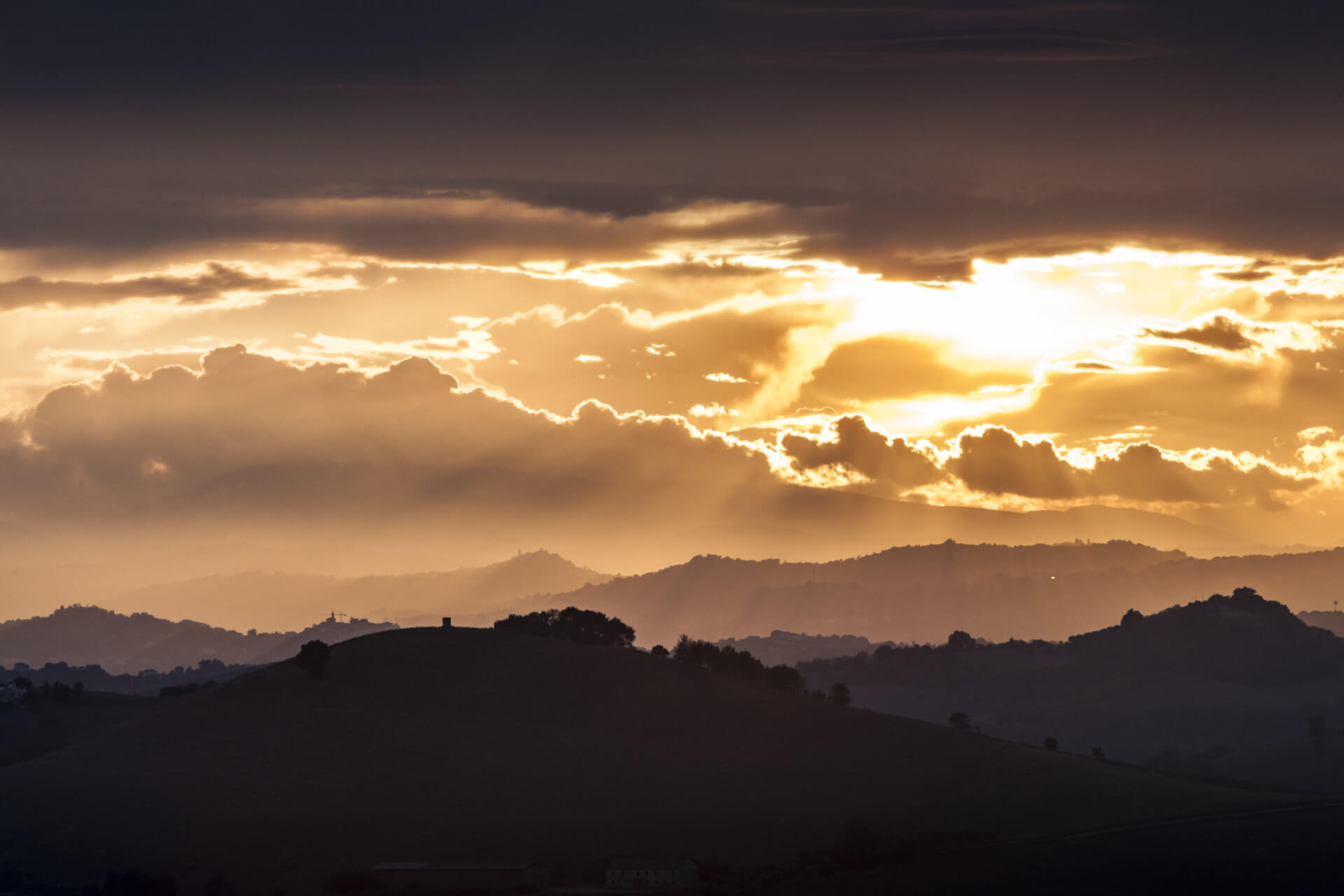
Torre di Palme at sunset. Photo: visitfermo.it
The Cavalcata dell'Assunta
On the 15th of August each year, the village takes part in Fermo's great historical re-enactment: the Cavalcata dell'Assunta. Torre di Palme is the oldest and most distant of the ten city quarters (contrade) that parade through Fermo in historical dress. The contrada's members carry a boat called Vincenzina — a nod to the village's fishing history — wearing the traditional costumes of the coastal inhabitants. If you're visiting in August, it's worth planning around this.
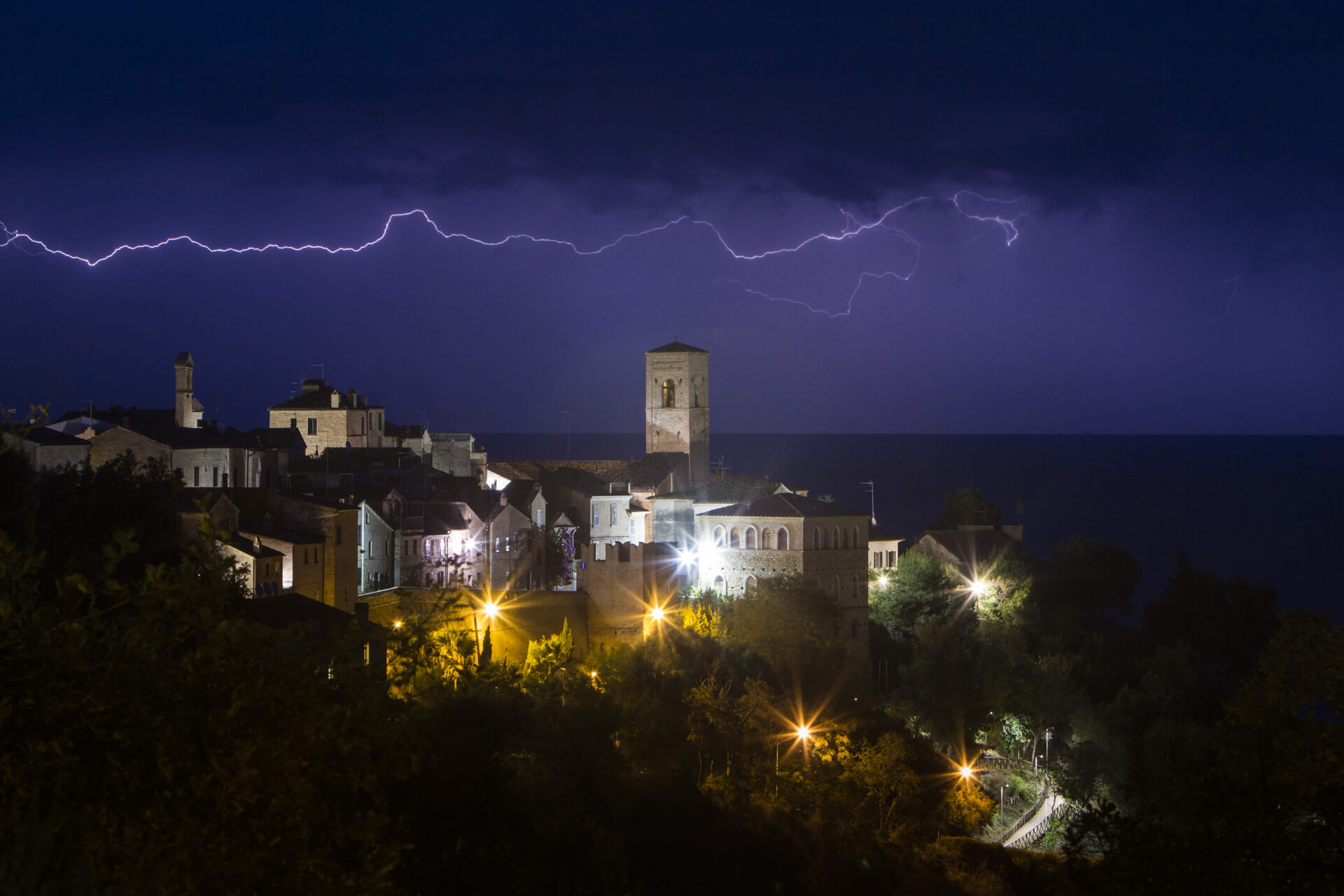
The village by night. Photo: visitfermo.it
How to visit
Torre di Palme is not set up for tourism in any significant sense. There are no ticket desks, no queues, no organised entrance. You park at the edge of the village (cars aren't allowed inside), walk in, and find your own way. The Archaeological Museum has irregular hours — check with the local tourist office before visiting.
The village is at its best early in the morning before the heat, or in the early evening when the light on the terracotta turns gold and the sea below goes a particular shade of blue. Both are achievable from Gelsomoro in roughly the time it takes to finish a coffee.
Torre di Palme is five minutes by car from Gelsomoro, our apartment in Borgo Casal Cristiana. All photos courtesy of Visit Fermo — visitfermo.it.