Porto Recanati sits at the northern edge of the Riviera del Conero, where the Adriatic curve begins to pull toward the limestone cliffs of Monte Conero. It's a fishing town turned seaside resort that hasn't entirely forgotten what it was — the boats still go out, the brodetto is still made the old way, and the castle at the centre of the piazza still dominates everything.
Nine kilometres of beach, a pedestrian lungomare, a Roman site buried in the sand, and a medieval castle named after the Swabian emperors. It's closer than you think.
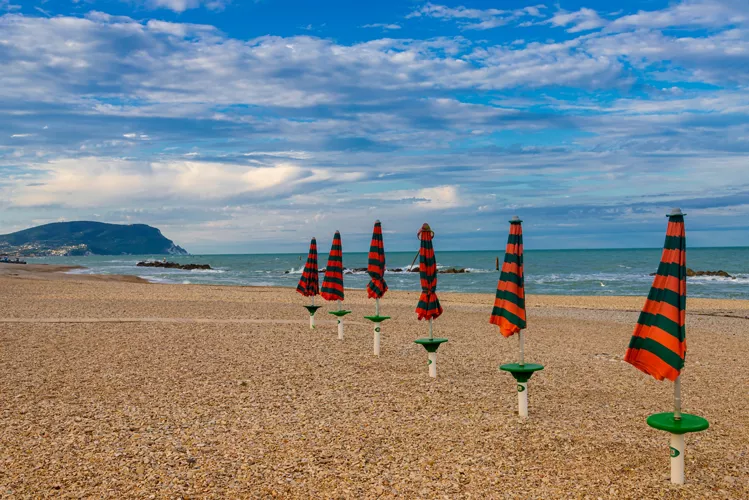
Porto Recanati, Le Marche. Photo: italia.it
The beach and the lungomare
The beaches at Porto Recanati have held the Bandiera Blu — the European coastal quality award — for years. Nine kilometres of Adriatic shoreline, and a long pedestrian promenade that runs the length of it. In July and August the lungomare fills with the rhythms of an Italian beach town: morning swimmers, afternoon shade under umbrellas, evening passeggiata.
The sea here is calm and shallow near the shore, which makes it well suited to families. The water quality that earns the Bandiera Blu isn't incidental — it's maintained by people who take it seriously.
Castello Svevo
The Castello Svevo rises above the central piazza. Built under the Swabian emperors — the Norman-Sicilian dynasty that ruled southern Italy through the 12th and 13th centuries — it's the town's most visible landmark and the anchor of its civic life. The castle has been restored and now houses cultural events and exhibitions through the summer months.
Below it, in the piazza, is the Arena Gigli — an open-air performance venue named after Beniamino Gigli, the great tenor born in nearby Recanati. Gigli was one of the defining voices of the early 20th century; the arena that bears his name hosts opera and classical concerts each summer.
Potentia — the Roman site in the dunes
At the southern edge of town, partly buried beneath the coastal dunes, lies Potentia — a Roman colony founded in 184 BC. Excavations have revealed streets, mosaics, and the outline of public buildings. It's not a grand, curated archaeological park, which is part of what makes it interesting: you're looking at a city that was simply absorbed by the landscape over two thousand years.
Brodetto portorecanatese
Every coastal town in Le Marche has its version of brodetto — the fish stew that is the region's most argued-over dish. Porto Recanati's version is particular: the fish come from local boats, the recipe is dictated by what the Adriatic gives up each morning, and the result is something that does not travel well. You need to eat it here.
Each June, the town holds the Settimana del Brodetto — a week dedicated to the dish, with restaurants competing on their interpretation of it and tastings open to visitors. If your timing allows, it's worth planning around.
Corso Matteotti and the antique markets
The main street, Corso Matteotti, runs through the old town and is the place for an evening walk. In summer, antique and crafts markets set up along the corso, particularly on weekend evenings — a low-key version of the same tradition you find at Fermo's Thursday market under the porticos.
Getting there from Gelsomoro
Porto Recanati is 40 minutes by car from Gelsomoro — a direct run north along the coast road. It's the natural complement to a morning at Civitanova Marche or an afternoon at Recanati itself, the hilltop town where Leopardi was born.
The combination of Bandiera Blu beaches, the castle, the Roman site, and a brodetto lunch makes it a full day with no effort at all.
Porto Recanati
Province of Macerata · Le Marche · 62017
40 minutes from Gelsomoro