The Sibillini mountains form the highest and most dramatic section of the Apennine chain in central Italy — a range that runs along the boundary between Le Marche and Umbria, with summits above 2,000 metres and valleys cut deep enough to feel genuinely remote. The national park that protects the area covers 70,000 hectares and contains some of the most extraordinary landscapes in Italy: not the manicured or the famous, but the kind that takes time and a certain willingness to drive into the hills to find.
The most celebrated of these landscapes — and justifiably — is the Piano Grande at Castelluccio di Norcia.

Fioritura, Piano Grande di Castelluccio di Norcia. Photo: italia.it
The Piano Grande and the fioritura
The Piano Grande is a high plateau — roughly 1,300 metres above sea level — surrounded on all sides by peaks. It is flat and wide in a way that feels wrong for the mountains, a circle of open plain with no apparent reason to exist at that altitude. The village of Castelluccio di Norcia sits on a hill at the edge of it, looking down over the plateau and across to the Vettore massif.
From late May through July, the plateau becomes one of the most photographed landscapes in Italy. The lentil fields — Lenticchia di Castelluccio IGP, a variety grown here since at least the Middle Ages — flower in sequence with the wild flora of the plain: poppies, cornflowers, narcissi, orchids, all in shifting blocks of colour that change week by week. This is the fioritura, and it is genuinely worth building a visit around. The colours are at their most intense in June, but the exact timing varies with the season.
Outside of the fioritura, the Piano Grande is quieter and, in its own way, more compelling — the scale of the plateau visible without the crowds, the light different, the mountains more present.
The mountains
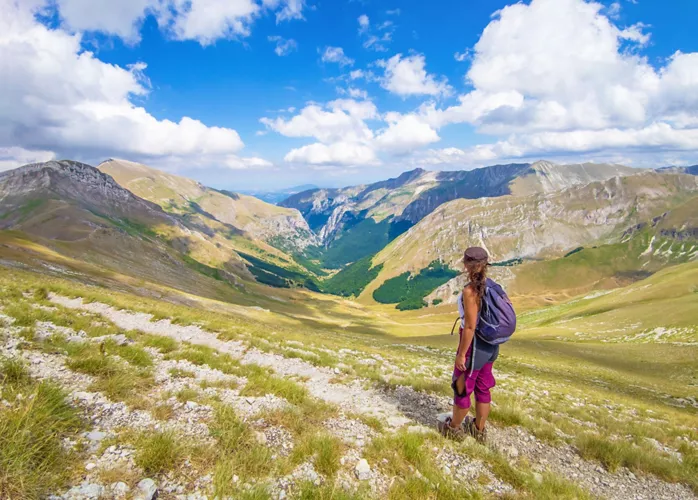
The highest peaks are on the Le Marche side. Monte Vettore (2,476m) is the summit of the range and one of the most frequently climbed peaks in the central Apennines — the route from the Forca di Presta pass is long but not technically demanding, and the views from the ridge extend to the Adriatic on one side and Umbria on the other. Monte Sibilla (2,173m) gives the range its name. Monte Bove (2,112m) lies further north and is particularly striking from the valleys below, its broad flanks rising almost directly from the plateau.
The park has over 450 kilometres of marked trails covering the full range — from long ridge routes to valley walks through beech and oak forest. Themed trails include the Sentiero dello Zafferano (Saffron Trail), which follows the ancient roads between the villages that cultivated and traded saffron — once one of the region's most valuable exports.
Monte Bove, Le Marche. Photo: italia.it
The Sibilla and the legend
The name comes from a legend that is older than the park and older, perhaps, than any written record of the mountains: a Sibyl — a sorceress or oracle — was said to live in a cave on the slopes of Monte Sibilla, drawing in knights and pilgrims who sought her wisdom and did not always return. The cave itself is a real place — a cleft in the rock near the summit — and was described in medieval texts including a 15th-century French romance that made the legend known across Europe. The Museo della Sibilla in Montemonaco holds manuscripts and artefacts documenting the long entanglement of the landscape with the story.
The villages
Norcia, just across the Umbrian border from the park's western edge, is a medieval city enclosed by 13th-century walls — the birthplace of Saint Benedict, the founder of Western monasticism. It is also the origin of the word norcineria: the tradition of pork butchery and charcuterie that defines much of this region's gastronomy. The prosciutto di Norcia IGP, the salami, the capocollo — all come from a tradition that has been continuous here since the Middle Ages.
The town was severely damaged by earthquakes in 2016, and parts of it remain under reconstruction. It is still worth visiting — the food, the market, the resilience of the place itself.
Castelsantangelo sul Nera, deep in the park on the Le Marche side, is one of the finest examples of medieval hill-town planning in the region — fortified walls, walkways, battlements, a layout determined entirely by the logic of defence. It is small and largely unvisited, which is part of why it has kept what it has.
Arquata del Tronto occupies an extraordinary position: it is the only town in Italy that falls within the boundaries of two national parks simultaneously — the Sibillini to the north and the Gran Sasso–Monti della Laga to the south. Like Norcia, it was damaged in 2016.
Food and what to eat
The gastronomy of the park is built around sheep farming, mountain agriculture, and the norcineria tradition. Lenticchie di Castelluccio IGP are the best-known product — small, flavourful, with a thin skin that means they hold their shape when cooked. They are served simply, with the local pecorino or as a base for the region's game. Pecorino from the plateau, fresh or aged ricotta, mixed-milk cheeses — all shaped by the transhumance routes that moved flocks between the Adriatic coast and these high pastures for centuries. Truffles (both black and white) are found throughout the park, and mushrooms in autumn.
From Gelsomoro and Casa della Nonna Elsa
The Sibillini are around 90 minutes from both our houses — west through the Le Marche interior, up into the hills past Amandola and Montemonaco, emerging onto the plateau. The drive itself is one of the better approaches to any mountain landscape in Italy: the plain gradually narrows, the hills close in, and then the Piano Grande opens out in front of you.
For a full day: arrive at Castelluccio in the morning, walk out onto the Piano Grande before the light changes, drive the park road to Norcia for lunch, and return via the eastern valleys through Arquata. If you're here in June — plan around the fioritura before almost anything else.
Parco Nazionale dei Monti Sibillini
Umbria and Le Marche · Park HQ: Via Achille Canzanese 1, Visso (MC)
~90 minutes from Gelsomoro and Casa della Nonna Elsa