Macerata has a particular quality among the hill towns of Le Marche — something quieter and more self-possessed than cities that have organised themselves around tourism. The medieval walls are almost entirely intact. The piazzas are unhurried. The university has been here since 1540, which means the rhythm of academic life — its bookshops, its bars, its particular mixture of the very young and the very old — has been woven into the fabric of the city for five centuries.
And every July and August, one of the most beautiful open-air venues in Italy opens its gates for opera.
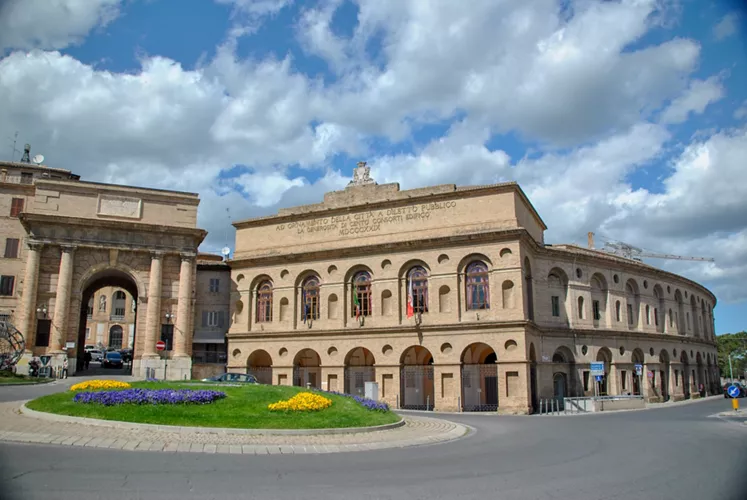
Lo Sferisterio, Macerata. Photo: italia.it
Lo Sferisterio
The Sferisterio is a neoclassical amphitheatre built in the 1820s for pallone a bracciale — an ancient game in which players struck a ball against a wall using a spiked wooden brace. The game required a long, curved arena; the citizens of Macerata built one that seats 6,000 and has proportions that happen to be perfect for opera.
The Macerata Opera Festival takes place here every July and August. Productions are staged at night, in the open air, against the warm stone of the curved wall — the kind of setting that makes productions you might have seen indoors feel like entirely different experiences. The festival has been running since 1921 and has featured many of the great names of 20th-century opera; it remains one of the most atmospheric venues for opera in Italy.
If you're staying with us in summer and opera is of any interest at all, it's worth planning around the Sferisterio's schedule before you book your stay.
Piazza della Libertà
The centre of Macerata is Piazza della Libertà, and its four sides are a survey of the city's history. The Palazzo del Comune faces the square; next to it the 16th-century Palazzo Apostolico, which now houses the Prefecture. The Torre Civica rises above one corner, its astronomical clock still marking the hours. The Loggia dei Mercanti — an arcaded merchants' hall — completes the composition.
On the same square, Palazzo Ricci holds a collection of 20th-century Italian art that is consistently underestimated: Medardo Rosso, Balla, Boccioni, De Chirico, and Burri, among others. It is a serious collection in a beautiful building that most visitors walk past without stopping.
Matteo Ricci
Macerata's most remarkable historical figure is Matteo Ricci (1552–1610) — a Jesuit priest born here who spent the second half of his life in China, becoming the first member of his order to be admitted to the imperial court of the Ming dynasty. He introduced Western mathematics, astronomy, and cartography to China; he translated Euclid into Chinese; he created maps of the world that showed China at the centre. When he died in Beijing in 1610, there were 300 Christian churches in China.
The city has not forgotten him. His birthplace is marked, the university bears his influence, and there is something in the intellectual tone of Macerata — a university city that has been producing scholars for five centuries — that feels continuous with the tradition he came from.
Palazzo Buonaccorsi
In Via Don Minzoni — the street that also runs through the university — Palazzo Buonaccorsi houses the Musei Civici with collections of ancient and modern art, and a Museo della Carrozza (coach museum) that is better than it sounds. The building's great room is the Sala dell'Eneide, with a frescoed vault depicting the Aeneid — one of the more spectacular interiors in the region.
The same street leads, after about two kilometres beyond Porta Picena, to the Bramantesque church of Santa Maria delle Vergini — an octagonal-domed church that once held Tintoretto's Adoration of the Magi. The Tintoretto is now in the Musei Civici.
The university city
The University of Macerata has operated continuously since 1540 — making it one of the oldest in the world. The faculties are spread along Via Don Minzoni and the surrounding streets, and the university presence gives the city a quality that purely tourist destinations rarely have: people actually live here, and have done so across many generations. The bars open early. The bookshops are good. The conversations in the piazza are not for the benefit of visitors.
From Gelsomoro and Casa della Nonna Elsa
Macerata is around an hour by car from both our houses — north through the Le Marche interior. It is best as a full day: a morning in the city and the museums, lunch in one of the trattorias near Piazza della Libertà, and — if your visit falls in July or August — an evening at the Sferisterio. The combination of the drive through the hills, the city at its summer best, and opera under the stars is one of the things that makes this part of Italy particular.
Check the festival programme at maceratopera.it before you go.
Macerata
Province of Macerata · Le Marche · 62100
~1 hour from Gelsomoro and Casa della Nonna Elsa