The Gola di Frasassi is a limestone gorge cut by the Sentino river into the Apennine hills west of Ancona — a narrow, dramatic valley where the rock walls rise several hundred metres above the road. It is the kind of landscape that signals something unusual underground, and in this case the intuition is correct. Beneath the gorge lies one of the most extensive cave systems in Europe: a network of chambers, tunnels, and formations that stretches for kilometres through the mountain and was almost entirely unknown until 1971.
The caves are visited by around half a million people a year. They are still extraordinary.
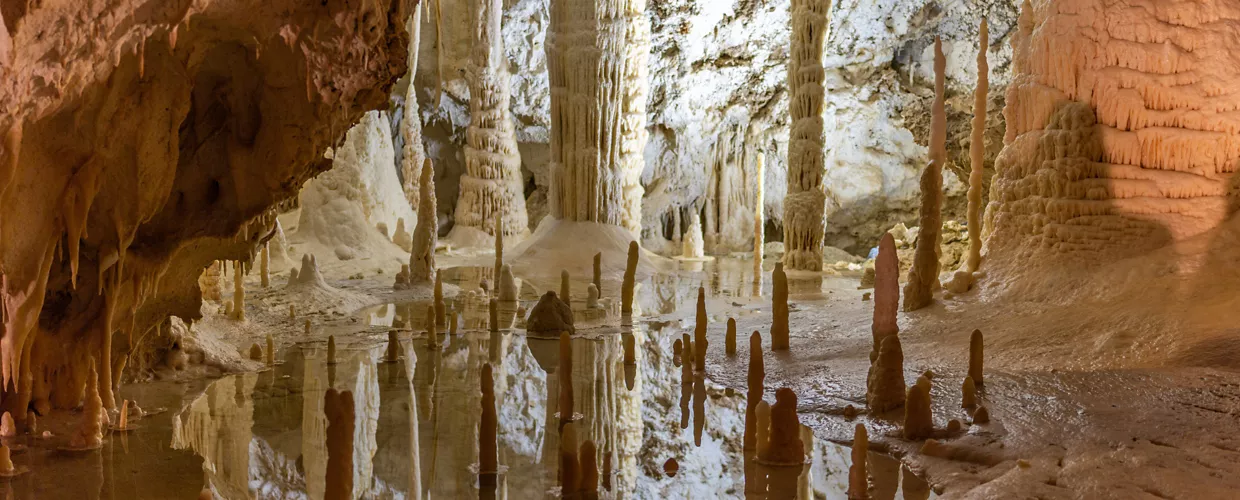
Grotte di Frasassi. Photo: italia.it
The discovery
On the 29th of September 1971, a group of speleologists from the CAI (Club Alpino Italiano) in Ancona descended 140 metres from the summit of the gorge and entered a cavity that had never been mapped. What they found was the Grotta Grande del Vento — the Great Cave of the Wind — an underground space of a scale that was genuinely unexpected: chambers wide enough to contain a cathedral, formations that had been growing in total darkness for millions of years.
A second cavity — the Grotta del Fiume (Cave of the River) — had been known since 1948, but its extent was unclear. In December 1971, speleologists from the CAI in Fabriano forced a narrow connecting passage and joined the two systems together. The full network had been discovered in the space of three months.
The caves were opened to the public in 1974.
Inside the caves
The standard visitor route begins in the Sala di Ancona — a single chamber approximately 100 metres high and 180 metres wide, wide enough to contain Milan's cathedral. The scale is disorienting in the best possible way: the ceiling disappears into darkness above you, and the floor is covered with the kind of formations that take geological time to produce.
From the Sala di Ancona, a series of tunnels leads through smaller chambers: the Sala Duecento, the Sala Infinito, the Canyon. The slow drip of water over millennia has built up a landscape of stalactites, stalagmites, cave pools, and crystalline deposits in forms that are strange and exact at the same time. The formations have been given names based on their shapes — the organ, the candles, the colonnade, the haystack, the frozen waterfall, the crystallised pool, the castle, the giants, the obelisk.
The artificial lighting is white and directional, designed to show the forms without falsifying the atmosphere. The temperature inside is a constant 14°C year-round — cool enough to require a light layer even in August.
The standard route covers approximately 1.5 kilometres and takes around 75 minutes with a guide.

Frasassi Avventura. Photo: italia.it
Frasassi Avventura
Beyond the standard tourist route, there are several alternative itineraries that go deeper into the cave system — the speleo-tourist routes, the speleo-adventure routes, and the full speleo-naturalist experience that takes you into sections of the cave that have never been adapted for tourism. These require advance booking, are led by expert guides, and include equipment (suit, helmet, headlamp) provided by the organisation. They are genuinely demanding and genuinely unlike the standard visit.
The gorge and what surrounds it
The Gola di Frasassi deserves time before or after the caves. The gorge road runs along the Sentino river through cliffs that are spectacular in morning light, and there are walking trails along both banks. The Riserva Naturale della Gola della Rossa e di Frasassi protects the wider area — a landscape of rare plants, birds of prey, and limestone formations that continues well beyond the cave entrance.
At the mouth of the gorge, the Abbazia di San Vittore alle Chiuse is an 11th-century Romanesque abbey built over an early Christian complex. The exterior is almost austere — the stone has the quality of everything that has been in the same place for a thousand years — and the interior holds the quiet that follows from it. It is not the reason most people come to Frasassi, but it is the kind of thing that stays with you.
The medieval village of Genga stands above the gorge — small, mostly unvisited, with views down over the valley.
Practical notes
Tickets should be booked in advance in summer — frasassi.com — as the cave entrance is timed and groups are limited in size. Wear a layer; 14°C feels cold after a warm August drive. The car park at the cave entrance is large and free.
From Gelsomoro and Casa della Nonna Elsa
Frasassi is around 90 minutes by car from both our houses — north along the coast to Ancona, then west through the hills towards Genga. It works well as a full day: the drive through the gorge itself is worth the trip, the cave visit takes most of the morning, and the abbey and a long lunch in Genga or the nearby town of Serra San Quirico fill the afternoon. Combine it with a stop in Jesi on the way back — a walled Renaissance city on the plain that is consistently underestimated, with a good Pinacoteca and a Verdicchio worth finding.
Grotte di Frasassi
Localita Gola di Frasassi · 60040 Genga (AN) · Le Marche
~90 minutes from Gelsomoro and Casa della Nonna Elsa
frasassi.com · +39 0732 90090