Urbino sits on a hilltop between the Metauro and Foglia valleys, visible from a distance by the distinctive twin towers of the Palazzo Ducale rising above the sandstone rooftops. The brick walls that enclose the old city are almost entirely intact. The streets inside them are narrow and mostly steep. The city is small enough to walk in an afternoon, and what it contains — in terms of art, architecture, and the density of Renaissance ambition concentrated in a single place — is extraordinary.
In 1998 UNESCO added Urbino to the World Heritage List, recognising that this hilltop town had been the point of convergence for the most significant artists and intellectuals of the Italian Renaissance, and had influenced the cultural development of the rest of Europe. The urban fabric it produced has survived almost unchanged.

Palazzo Ducale, Urbino. Photo: italia.it
Federico da Montefeltro and the golden century
The city's defining moment was the second half of the 15th century, under Federico da Montefeltro — soldier, humanist, and one of the most remarkable patrons in the history of Italian art. Federico assembled at his court in Urbino the best that Renaissance culture could offer: Piero della Francesca, Luciano Laurana, Leon Battista Alberti, and Giovanni Santi — who was a painter himself, and the father of Raphael.
The court Federico built was not simply wealthy. It was intellectually serious — a place where the manuscript library, the architectural programme, the painting collection, and the philosophical conversation were all treated as parts of the same project. The result was a city that became a model for courts across Europe, and a Palazzo Ducale that remains one of the finest buildings of the Italian Renaissance.
Palazzo Ducale and the Galleria Nazionale delle Marche
The Palazzo Ducale dominates the city from Piazza Duca Federico. Built for Federico da Montefeltro and designed largely by Luciano Laurana, it is an architectural masterpiece — the courtyards, the studiolo (Federico's private study, with extraordinary intarsia woodwork), the proportions of every room a lesson in Renaissance spatial thinking.
Inside the Palazzo, the Galleria Nazionale delle Marche holds one of the most important collections of 15th and 16th-century Italian painting in existence. Piero della Francesca's La Flagellazione di Cristo is here — a small panel painting that has generated more scholarly analysis than almost any other work of its period, and which is even stranger and more beautiful in person than in reproduction. Raphael's La Muta and Federico Barocci's work are also in the collection. The Museo Archeologico Lapidario occupies another wing.
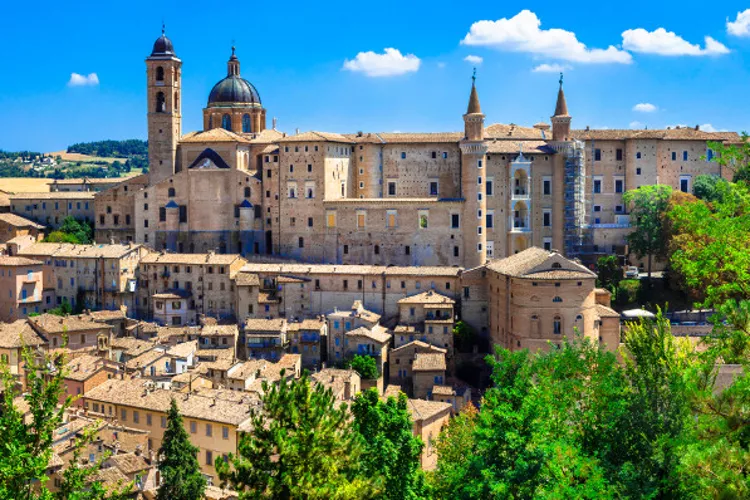
Urbino, Le Marche. Photo: italia.it
Raphael's birthplace
Raffaello Sanzio was born in Urbino in 1483, the son of Giovanni Santi. His birthplace — Casa Santi, a few minutes' walk from the Palazzo Ducale — is now a museum that holds paintings by Raphael and his father, as well as a fresco attributed to the young Raphael in the room where he was born. The house is modest; what surrounds it — the city his father worked in, the court his father served — is not.
The oratorio, the fortress, and San Bernardino
Beneath the cathedral of Santa Maria Assunta (rebuilt after the 1789 earthquake) lies the Oratorio del Santissimo Crocifisso della Grotta — four chapels built between the 16th and 17th centuries, containing a Pietà in marble by Giovanni Bandini (1597). It is the kind of place you find by going slightly below ground, which feels appropriate for a city that has this many layers.
The Fortezza Albornoz, built in the second half of the 14th century on the highest point in the city, gives the best views of the surrounding countryside — the hills rolling away in every direction, the valleys invisible below.
Just outside the historic centre, the Chiesa di San Bernardino was commissioned by Federico da Montefeltro as his burial church and that of his son Guidobaldo. The Baroque marble sarcophagi are still near the entrance, in a church that Federico chose for its position above the city — visible from the valleys below, as his palace was visible from even further away.
From Gelsomoro and Casa della Nonna Elsa
Urbino is around 90 minutes by car from both our houses — north through the Le Marche interior, past Macerata and into the hills of the Pesaro-Urbino province. It is properly a full-day trip: the drive is beautiful, the city rewards a slow morning and a long afternoon, and the Galleria Nazionale alone justifies the distance. Combine it with a stop in Gradara on the way back — a medieval walled village 30 minutes north of Urbino on the coast road.
Urbino
Province of Pesaro-Urbino · Le Marche · 61029 · UNESCO World Heritage Site
~90 minutes from Gelsomoro and Casa della Nonna Elsa