Seven kilometres from the sea, perched on a steep hill between the valleys of the Tenna and the Ete Vivo, Fermo is the kind of city that surprises you. You come for a morning, you stay for lunch, and you leave making a note to return.
The Cathedral dominates from above. The streets below are narrow and winding, still paved in cotto — the fired terracotta brick that is a living trace of the Roman and medieval city beneath the current one. The views open unexpectedly: between rooftops, through archways, at the end of an alley that suddenly drops away to show you the sea.
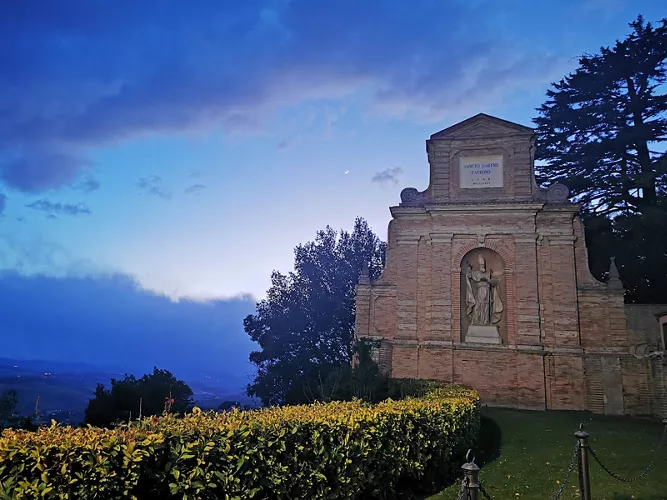
Fermo, Le Marche. Photo: italia.it
Piazza del Popolo
The heart of Fermo is Piazza del Popolo — not just a square, but the city's living room. It's framed by two porticoed loggias and has been the centre of civic life here for centuries. Markets, meetings, political events, and on Thursday evenings in summer, an antiques and crafts market that spreads under the porticos from July to August.
The buildings around the square are the city's résumé. The Renaissance Palazzo dei Priori holds the Pinacoteca civica on its upper floors — a collection of painting and sculpture worth more time than most visitors give it. At its centre is the Sala del Mappamondo, named for a 1713 world map drawn by the cartographer Amanzio Moroncelli of Fabriano. It's one of those rooms that stops you mid-stride.
Look up when you walk the loggetta pensile — the covered walkway that connects the Palazzo dei Priori to the Palazzo degli Studi. The frescoes on the vaulted ceiling are easy to miss if you're looking straight ahead.
The Duomo
The Cathedral of the Assumption sits at the top of the Girfalco hill — the highest point in the city, from which the views stretch to the Sibillini mountains in one direction and the Adriatic in the other. The facade is asymmetric and built in Istrian stone, which gives it an unusual quality in morning light.
Inside: a 12th-century Greek-Byzantine icon, and beneath the current nave, the remains of a 5th-century mosaic floor from the paleochristian church on which the cathedral was built. Fermo's history goes deep — quite literally.
Under the city: the Roman cisterns
Beneath the city lie the Cisterne Romane di Fermo — a vast Roman water system from the 1st century AD, one of the best preserved in the world. The cisterns were built to supply the Roman theatre and city, and their vaulted underground chambers stretch for hundreds of metres. They're cool in summer, uncrowded, and genuinely extraordinary.
If you're visiting with children, or if you simply want to understand how much city is stacked under this city, the cisterns are not optional.
Corso Cefalonia and the side streets
Between Corso Cavour and Corso Cefalonia, the 15th-century palazzetti and Renaissance buildings give a sense of what Fermo looked like at its most prosperous. The dark stone of the side streets and the sudden openings onto the countryside below make walking here feel genuinely exploratory — the city hasn't been over-smoothed for visitors.
From Gelsomoro
Fermo is 20 minutes by car from Gelsomoro — inland and uphill, through the agricultural landscape of the Fermo province. It's exactly the right size for an afternoon: small enough to walk without a plan, large enough to fill a few hours without trying.
The Thursday evening antiques market under the porticos is a good reason to time a visit. So is a long lunch in one of the restaurants around Piazza del Popolo, where the regional cooking — vincisgrassi, brodetto, local cheeses — is done without ceremony and done well.
Fermo
Province of Fermo · Le Marche · 63900
20 minutes from Gelsomoro · UNESCO Learning City