There is a moment when you arrive at Piazza del Popolo in Ascoli Piceno and stop walking. Not because you need to check something on your phone. Because the square in front of you is entirely built in travertine — the warm, cream-coloured limestone that the Romans quarried from the hills around here — and in certain light, late morning or early evening, it glows.
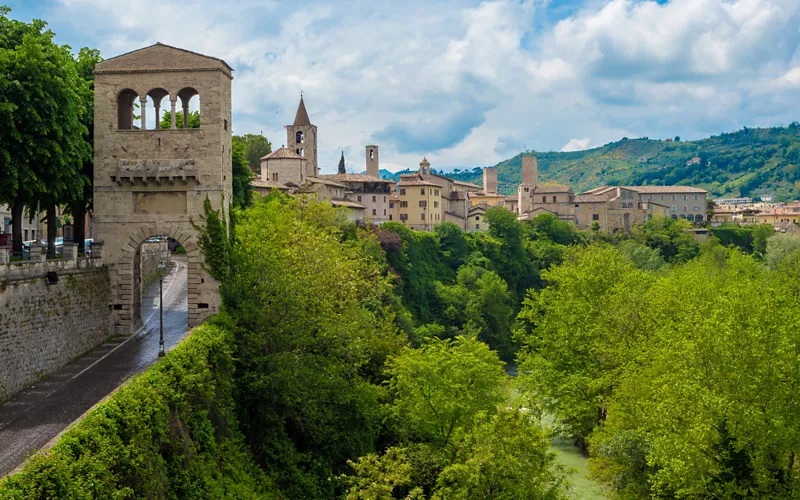
Ascoli Piceno is called la città delle cento torri — the city of a hundred towers — and del bien vivre. Both names are accurate. It is a city of medieval towers and Renaissance palaces, Roman bridges and Baroque churches, all in the same warm stone. And it is a city where people still seem to know how to live well.

Ascoli Piceno, Le Marche. Photo: italia.it
Piazza del Popolo
The heart of the city is Piazza del Popolo, and it is, without qualification, one of the most beautiful piazzas in Italy. The porticoes of the Palazzo dei Capitani run along one side — its medieval crenellated tower rising above everything. The church of San Francesco closes the far end. The whole thing is in travertine, and the proportions are perfect in the way that Italian urban spaces from this period could be perfect: as if the city grew up around this square because there was nowhere more logical to be.
On the adjacent Piazza Arringo sits the Palazzo Arringo, which houses the Pinacoteca civica — a collection that includes works by Turner, Morelli, Pellizza da Volpedo, and De Carolis. It is one of those provincial museums that repays proper attention.
Ascoli Piceno. Photo: italia.it
History in stone
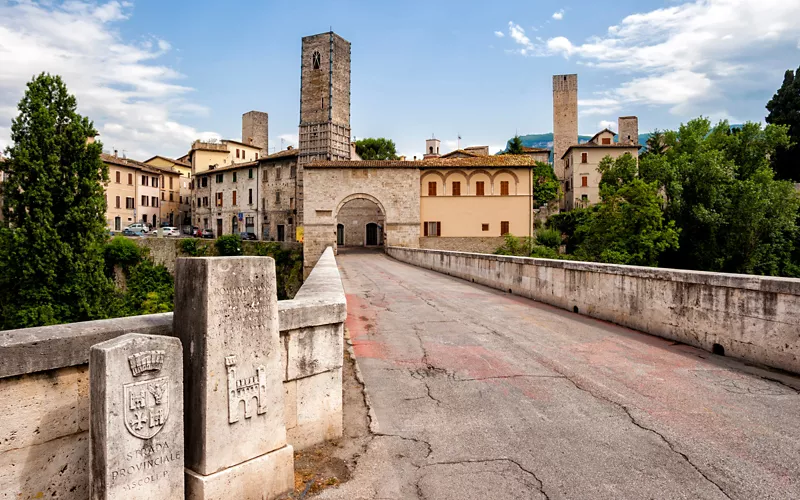
The travertine is not just aesthetics — it is the record of a very long history. Ascoli was settled in the Neolithic period; by the 3rd century BC, the Romans had established Asculum as a strategic hub on the Via Salaria, the ancient salt road that ran from the Adriatic across the Apennines to Rome. The city's prosperity under Rome left traces that are still visible: the Ponte romano, the old Roman bridge, still carries foot traffic across the Tronto today.
The medieval centuries brought the towers — built by rival noble families as expressions of power, most of them still standing. Then the Malatesta, the Sforza, and eventually the Papal States, under whose control Ascoli remained until the mid-19th century.
In September 1943 the city's partisans led one of the most significant acts of resistance against the German occupation in Le Marche. In 2001, Ascoli Piceno was awarded the Medaglia d'Oro al Valor Militare for its role in the partisan movement.
What to see
Forte Malatesta is the fortified stronghold built by the Malatesta family on the eastern edge of the old centre. The Duomo di Sant'Emidio dominates Piazza Arringo. The Chiesa di San Francesco closes off Piazza del Popolo on its southern end. The Musei della Cartiera Papale document the papal paper mills that operated here for centuries.
None of this requires a programme. Ascoli is small enough to discover on foot, and the streets are compact enough that you will find things without looking for them.
Ascoli Piceno. Photo: italia.it
Caffè Meletti and the anisetta
Before you leave the piazza, stop at Caffè Meletti. It has been on Piazza del Popolo since 1905 and has always been the kind of place where the city's notable figures gather — writers, politicians, merchants, a few people who are simply very old. Order the anisetta, the local liqueur made from green anise that Meletti has been distilling since the same year the café opened. It is not for everyone, but it is very much of this place.
The olive ascolane
The olive all'ascolana were invented here. The original: large, soft green olives, pitted, stuffed with a spiced meat mixture, coated in breadcrumbs, fried. The version you find elsewhere in Italy is usually a pale approximation. In Ascoli, at a good friggitoria or at a serious kitchen, they are something else entirely.
Stefano Esposto at Figli Di — the restaurant we know well in the historic centre — makes them as they should be made. If you are going to eat them anywhere, eat them here. Read our post about Figli Di →
From Gelsomoro and Casa della Nonna Elsa
Ascoli Piceno is around 45 minutes by car from both our houses — south through the Tronto valley or directly inland from Monterubbiano. It is best as a proper half-day: arrive mid-morning, walk the piazza, visit the Pinacoteca if you have the inclination, eat well at lunch, walk off the olive ascolane in the afternoon. There is no need to rush.
Ascoli Piceno
Province of Ascoli Piceno · Le Marche · 63100
~45 minutes from Gelsomoro and Casa della Nonna Elsa